
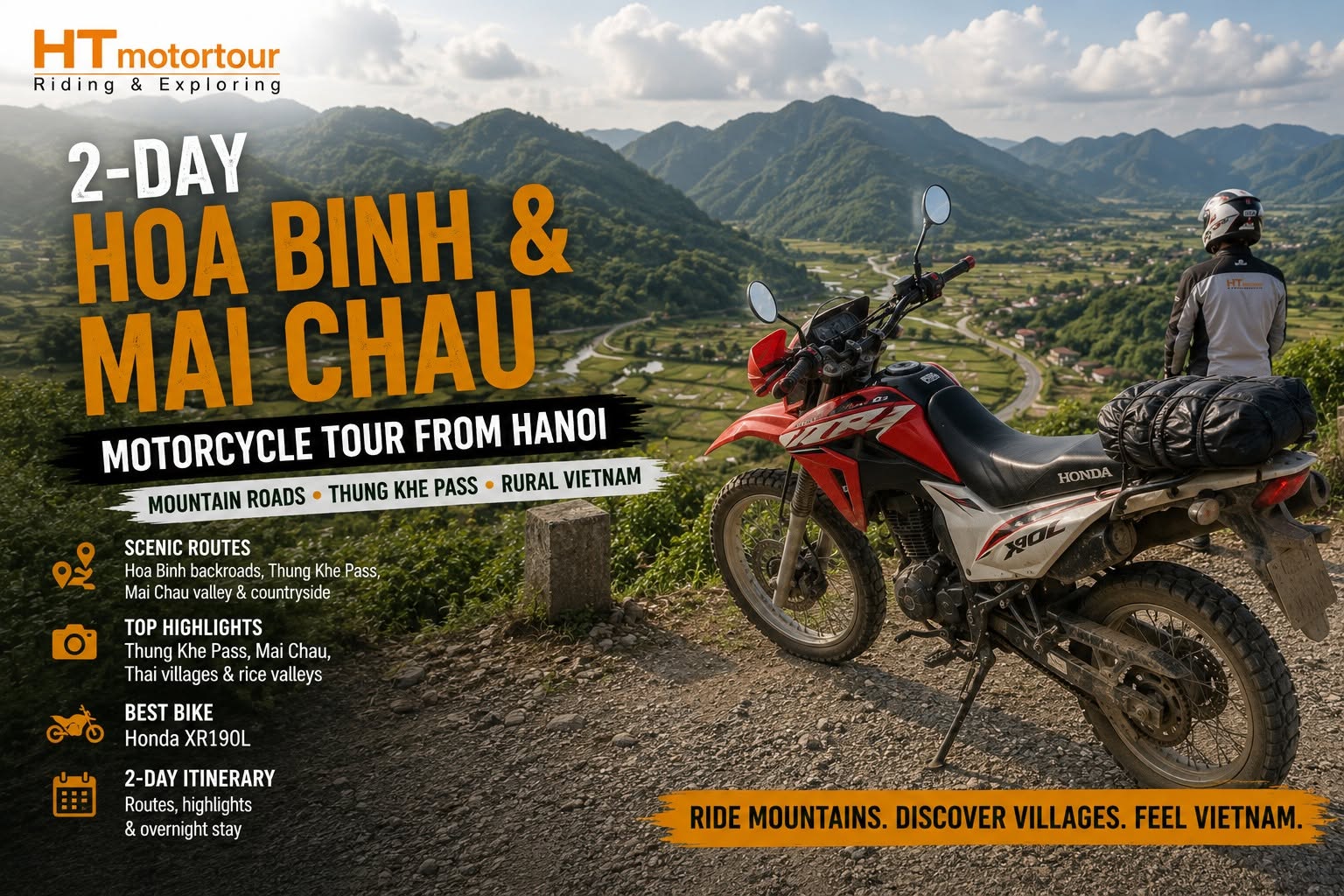

TL;DR: This 2-day Hoa Binh & Mai Chau motorcycle tour is designed for riders who want a real Northern Vietnam mountain-road experience without committing to a long Ha Giang trip. Ride from Hanoi through Hoa Binh and Thung Khe Pass, stay in Mai Chau, then return via quieter countryside roads.
If you have only two days available from Hanoi, you don’t need to spend your entire trip chasing Vietnam’s most famous motorcycle destinations.
There is a much simpler option.
Ride west.
Leave Hanoi behind.
Cross the countryside around Hoa Binh.
Climb toward Thung Khe Pass.
Then descend into the green valley of Mai Chau.
This route works because the journey itself is part of the experience.
You get mountain roads, limestone scenery, rice fields, local villages and Thai culture without spending four or five days away from Hanoi.
And importantly, this isn’t designed as a bus transfer with a motorcycle added somewhere along the way.
You ride from Hanoi into the mountains.
Why Choose a 2-Day Hoa Binh & Mai Chau Motorcycle Tour?
Direct answer: This route is ideal for international travellers who want a genuine two-day motorcycle adventure from Hanoi, combining Hoa Binh’s mountain scenery and Thung Khe Pass with Mai Chau’s rice valleys and Thai villages without the time commitment required by longer Northern Vietnam routes.
The biggest advantage is simple:
distance.
Mai Chau is close enough to Hanoi to make a proper two-day motorcycle journey realistic.
You don’t lose the first day travelling hundreds of kilometres simply to reach the mountains.
Instead, the landscape changes progressively.
Hanoi becomes countryside.
Countryside becomes Hoa Binh.
Hoa Binh becomes mountains.
The mountains open into Mai Chau Valley.
That progression makes the route feel like an adventure.
Is This Different from a 2-Day Mai Chau Motorcycle Tour?
Direct answer: Yes, if the route is built around Hoa Binh rather than treating Hoa Binh as a simple transit point. The purpose of this tour is to highlight the complete Hanoi–Hoa Binh–Thung Khe–Mai Chau riding experience rather than selling another generic Mai Chau overnight trip.
HT Motor Tour already has a dedicated 2-Day Mai Chau Motorcycle Tour from Hanoi, so this page must have a distinct search intent and itinerary architecture rather than competing with that page.
Think of the two pages like this:
2-Day Mai Chau Motorcycle Tour
Destination-led
Hanoi → Mai Chau → explore Mai Chau → Hanoi
2-Day Hoa Binh & Mai Chau Motorcycle Tour
Route-led
Hanoi → Hoa Binh → mountain roads → Thung Khe Pass → Mai Chau → countryside → Hanoi
That distinction matters for both users and SEO.
We are not creating another page simply because we can.
We are targeting another search.
2-Day Hoa Binh & Mai Chau Motorcycle Tour at a Glance
Direct answer: The most balanced itinerary starts in Hanoi, crosses rural roads toward Hoa Binh, climbs through the Thung Khe mountain section and reaches Mai Chau on Day 1, followed by valley riding and a scenic return to Hanoi on Day 2.
| Detail | Tour |
|---|---|
| Duration | 2 days / 1 night |
| Start | Hanoi |
| Finish | Hanoi |
| Main route | Hanoi → Hoa Binh → Thung Khe → Mai Chau |
| Riding level | Easy–Moderate |
| Main scenery | Mountains, rice fields, valleys |
| Main cultural experience | Thai villages |
| Overnight | Mai Chau |
| Recommended bikes | XR150L / XR190L / CRF300L |
| Larger option | Himalayan 450 |
| Tour style | Guided or self-ride |
| Best for | International riders with 2 days |
| Adventure level | Moderate |
The exact route should always depend on:
- Weather.
- Traffic.
- Road conditions.
- Rider experience.
- Season.
- Whether you want more sightseeing or more riding.
A good motorcycle tour isn’t a GPS file carved in stone.
Day 1: Hanoi → Hoa Binh → Thung Khe Pass → Mai Chau
Direct answer: Day 1 is the more mountainous riding day, taking you from Hanoi through rural roads and Hoa Binh before climbing toward Thung Khe Pass and descending into Mai Chau Valley for an overnight stay in a local homestay or hotel.
Leave Hanoi in the morning.
The first objective is simple:
escape the city.
Once you’re away from the busiest urban roads, the ride starts changing.
Rice fields appear.
Villages become smaller.
The horizon opens.
Then the terrain begins to rise.
This is where Hoa Binh becomes important.
Hanoi to Hoa Binh by Motorcycle
Direct answer: The Hanoi–Hoa Binh section is the transition between the Red River Delta and Northern Vietnam’s mountain environment, and a locally chosen route can make the journey more enjoyable than simply following the fastest highway connection.
This part of the ride isn’t about collecting kilometres.
It’s about getting into the rhythm of the trip.
You pass through rural communities and agricultural areas before reaching the more mountainous landscape around Hoa Binh.
Depending on conditions, the guide can choose roads that balance:
safety + scenery + riding quality.
That flexibility is particularly useful in Vietnam.
Traffic changes.
Weather changes.
Road conditions change.
A good local guide adapts.
Hoa Binh: Where the Landscape Starts to Change
Direct answer: Hoa Binh provides the natural transition from Hanoi’s lowland countryside into the limestone mountains and valleys of Northwest Vietnam, making it an important part of the riding experience rather than simply a place to stop for lunch.
Hoa Binh is often overlooked because travellers are focused on reaching Mai Chau.
From a motorcycle, that is a mistake.
The approach gives you increasingly mountainous scenery, rural settlements and winding roads.
This is also where you start to feel the difference between:
travelling to Mai Chau
and
riding to Mai Chau.
Thung Khe Pass: The Highlight of Day 1
Direct answer: Thung Khe Pass is the main mountain-riding section between Hoa Binh and Mai Chau, offering winding roads, elevated viewpoints and a dramatic change in scenery before the descent into Mai Chau Valley.
This is where the ride becomes properly mountainous.
The road climbs.
The bends tighten.
The views open.
Then the valley appears below.
Don’t treat the pass as a race.
Mountain roads reward patience.
Slow before blind corners.
Maintain a comfortable line.
Leave space for local traffic.
And stop only where it is safe.
The objective isn’t to prove how fast you can ride the pass.
It’s to enjoy it.
Arriving in Mai Chau Valley
Direct answer: Arriving in Mai Chau after crossing the mountain section creates a strong contrast between the road and the destination: the highland route gives way to a broad green valley surrounded by limestone mountains, rice fields and traditional villages.
This is the part where you slow down.
Park the motorcycle.
Walk through the village.
Explore the rice fields.
Meet local people.
And, depending on the accommodation and itinerary, stay overnight in a traditional Thai-style homestay.
The evening is deliberately different from the riding day.
No need to keep moving.
You’ve already arrived.
Thai Village Life in Mai Chau
Direct answer: Mai Chau’s Thai communities and traditional stilt houses provide the cultural element that makes this route more than a mountain-road motorcycle trip, giving riders time to experience local village life rather than simply photograph the landscape.
The valley is famous for its Thai communities, traditional houses and agricultural landscape.
A homestay gives you the chance to experience a slower evening.
Dinner.
Conversation.
Village walks.
And, depending on the local programme, traditional cultural performances.
The exact experience can vary.
That’s part of travelling in rural Vietnam.
Day 2: Explore Mai Chau → Countryside Roads → Hanoi
Direct answer: Day 2 should not simply reverse Day 1 at maximum speed; the better approach is to spend the morning exploring Mai Chau before taking a scenic return route through rural Northern Vietnam toward Hanoi.
Start with breakfast in the valley.
Then ride.
The morning light is usually better for photography, and the valley is quieter before the day’s traffic increases.
Depending on your preference, the route can include:
- Rice-field roads.
- Thai villages.
- Small mountain roads.
- Local markets.
- Rural viewpoints.
- Quiet countryside sections.
Then gradually head back toward Hanoi.
Why Take a Different Return Route?
Direct answer: A different return route makes the two-day journey feel like a genuine motorcycle loop rather than simply travelling to Mai Chau and immediately retracing the same road, while also giving the guide more flexibility to select suitable roads for the day’s conditions.
This is one of the advantages of booking locally.
The itinerary can be adjusted.
If the weather is excellent:
ride more.
If rain arrives:
choose safer roads.
If everyone wants photography:
slow down.
If the group wants more riding:
add a scenic section.
The route should serve the riders.
Not the other way around.
How Much Riding Is Involved?
Direct answer: Expect a full but manageable two days on the motorcycle, with the exact distance changing according to the roads selected, stops and riding style rather than being fixed around a single kilometre target.
For reference, competing two-day Mai Chau tours commonly advertise roughly 160–180 km on Day 1 and another 170 km or so on Day 2, while other operators advertise around 200 km for the first day.
HT should therefore avoid promising an artificially precise distance unless the actual route is fixed.
A better promise is:
two full days of riding through Northern Vietnam.
What Is the Riding Difficulty?
Direct answer: The standard Hoa Binh–Mai Chau route is suitable for riders with basic to intermediate motorcycle experience, with the main challenge coming from Vietnamese traffic, mountain bends and changing road conditions rather than extreme off-road terrain.
I’d describe it as:
Easy → Moderate
You should already be comfortable with:
- Clutch control.
- Braking.
- Cornering.
- Riding in traffic.
- Starting and stopping on uneven roads.
You do not need to be an extreme enduro rider.
This is precisely why the route works as a short Northern Vietnam motorcycle tour.
Which Motorcycle Should You Ride?
Direct answer: The Honda XR150L is the most practical choice for most riders on this route, while the XR190L and CRF300L suit riders wanting more power or additional capability. A Himalayan 450 is suitable for experienced riders who prefer a larger adventure motorcycle.
Honda XR150L
Best all-round choice.
Light.
Simple.
Easy to control.
Good on mountain roads.
Good for two-day luggage.
Honda XR190L
A little more power while keeping the manageable dual-sport character.
Honda CRF300L
Better suited to riders who want to extend the route onto rougher roads.
Royal Enfield Himalayan 450
A strong option for experienced riders who prefer a larger adventure motorcycle.
But bigger isn’t automatically better.
On narrow rural roads, a lighter motorcycle can actually be more enjoyable.
Guided Motorcycle Tour or Self-Ride?
Direct answer: A guided tour is best for riders who want local roads, navigation and support without worrying about route planning, while self-riding is better for experienced Vietnam riders who prefer independence and already understand local traffic.
Choose a guided tour if you want:
- Local route knowledge.
- No navigation stress.
- Flexible stops.
- Local food recommendations.
- Mechanical support.
- A structured itinerary.
Choose self-ride if you:
- Already ride confidently.
- Prefer independence.
- Are comfortable navigating Vietnam.
- Want to control your own pace.
HT can serve both types of travellers because the business also provides motorcycle rental from Hanoi.
Is This Tour Suitable for First-Time Vietnam Riders?
Direct answer: Yes, for riders who already have motorcycle experience but are new to Vietnam, this is a more approachable introduction to Northern Vietnam than a demanding high-mountain route such as Ha Giang, although riders should still take Vietnamese traffic and mountain roads seriously.
There is a big difference between:
first time riding in Vietnam
and
first time riding a motorcycle.
If you’ve ridden motorcycles before, we can help you adapt to Vietnam.
If you’ve never ridden a manual motorcycle, tell us.
The correct answer may be an Easy Rider arrangement rather than forcing you onto a motorcycle.
Best Time for a Hoa Binh & Mai Chau Motorcycle Tour
Direct answer: Spring and autumn are generally comfortable seasons for riding around Hoa Binh and Mai Chau, while May and early June can be especially attractive for rice-field scenery; summer brings more heat and rain, so routes should remain flexible.
February–April
Comfortable temperatures and good conditions for riding.
May–June
Green and agricultural landscapes are particularly attractive.
July–August
Hot, humid and wetter.
September–November
One of the better periods for comfortable riding.
December–January
Cooler conditions, especially in the mountains.
There is no single perfect month.
The best time depends on whether you prioritise:
weather, rice fields, riding comfort or fewer tourists.
What to Pack for Two Days
Direct answer: Pack light because you only need two days of riding; leave large luggage in Hanoi and carry only essential riding gear, clothing, documents, rain protection and personal items.
Bring:
- Passport.
- Motorcycle licence and required documents if self-riding.
- Riding gloves.
- Comfortable shoes.
- Rain jacket.
- Lightweight clothing.
- Sunscreen.
- Sunglasses.
- Phone.
- Power bank.
- Small amount of cash.
- Personal essentials.
A small backpack is enough.
Is the Hoa Binh & Mai Chau Motorcycle Tour Safe?
Direct answer: The route is manageable for competent riders, but safety depends heavily on speed, road awareness, weather and traffic. Mountain sections such as Thung Khe should be ridden conservatively, especially around blind corners and changing road surfaces.
The biggest safety rule is simple:
don’t ride faster than your visibility allows.
You may encounter:
- Cars.
- Trucks.
- Buses.
- Local motorcycles.
- Pedestrians.
- Animals.
- Wet surfaces.
- Unexpected roadside activity.
Leave yourself space.
Don’t copy the riding style of locals.
And don’t let an itinerary dictate your speed.
2-Day Hoa Binh & Mai Chau vs 2-Day Ninh Binh
Direct answer: Choose Hoa Binh and Mai Chau if you want more mountain riding and a traditional valley experience; choose Ninh Binh if you prefer limestone scenery, rivers, caves, ancient history and a more sightseeing-focused trip.
| Hoa Binh + Mai Chau | Ninh Binh | |
|---|---|---|
| Mountain riding | Excellent | Moderate |
| Mountain pass | Thung Khe | Limited |
| Rice fields | Excellent | Excellent |
| Thai villages | Yes | No |
| Boat trip | No | Yes |
| Ancient history | Moderate | Excellent |
| Riding adventure | Higher | Lower |
| Best for | Mountain riders | Culture + scenery |
| From Hanoi | Short | Short |
This is also why HT should not market every short tour as the same product.
Different traveller. Different reason to ride.
2-Day Hoa Binh & Mai Chau vs Ha Giang
Direct answer: Hoa Binh and Mai Chau are the better choice for a short two-day escape from Hanoi, while Ha Giang is better for riders whose priority is dramatic high-mountain riding and who have enough time for a longer journey.
Choose Hoa Binh & Mai Chau if:
- You have exactly two days.
- You want to stay close to Hanoi.
- You prefer moderate riding.
- You want Thai culture.
- You want a mountain experience without a long expedition.
Choose Ha Giang if:
- Riding is the main purpose.
- You want major mountain passes.
- You’re an experienced rider.
- You have at least several days.
Don’t choose a destination simply because it is famous.
Choose the one that fits your time.
Can You Extend the Tour to Pu Luong?
Direct answer: Yes. Riders with an additional day can extend the route from Mai Chau toward Pu Luong, creating a stronger mountain-and-valley motorcycle experience instead of returning directly to Hanoi.
This is where the trip becomes more adventurous.
Mai Chau gives you:
valley + Thai villages + rice fields.
Pu Luong adds:
terraces + forest + smaller mountain roads + more remote villages.
HT already has a dedicated 3-Day Mai Chau & Pu Luong Motorcycle Tour from Hanoi, so this should be an internal upsell rather than creating another competing two-day page.
Who Should Book This 2-Day Motorcycle Tour?
Direct answer: This tour is designed for international travellers who have only two days available from Hanoi but want actual mountain riding, local culture and countryside scenery rather than a conventional sightseeing transfer.
It’s particularly suitable for:
- Solo riders.
- Couples.
- Small groups.
- Experienced motorcycle travellers.
- First-time Vietnam riders with riding experience.
- Travellers with limited time.
- Riders who don’t want the intensity of Ha Giang.
- People looking for short motorcycle tours from Hanoi.
Who Should Choose Another Route?
Direct answer: Riders looking for extreme off-road terrain, very high mountain passes or a longer expedition should choose a more demanding Northern Vietnam route rather than trying to turn this short tour into something it is not.
Choose another route if your priority is:
serious off-road riding → consider a more technical itinerary.
dramatic high passes → consider Ha Giang.
three days → consider Mai Chau + Pu Luong.
relaxed sightseeing → consider Ninh Binh.
The best tour is not necessarily the most difficult one.
Book a 2-Day Hoa Binh & Mai Chau Motorcycle Tour from Hanoi
Two days is enough to get properly out of Hanoi.
You can leave the city behind, ride into Hoa Binh, climb through the mountains, cross Thung Khe Pass, descend into Mai Chau Valley and spend the night surrounded by rice fields and villages.
The next morning, get back on the motorcycle and take the scenic way home.
No airport.
No long bus transfer.
No five-day commitment.
Just:
Hanoi → Hoa Binh → Thung Khe → Mai Chau → Hanoi.
HT Motor Tour can tailor the trip around:
- Your travel dates.
- Number of riders.
- Riding experience.
- Motorcycle preference.
- Guided or self-ride.
- Standard or more adventurous route.
For riders who want to continue beyond Mai Chau, we can extend the journey toward Pu Luong and other Northwest Vietnam routes.
For riders who prefer independence, HT also offers motorcycles for rental from Hanoi.
Send us your dates, number of riders and preferred motorcycle, and we’ll recommend the route that makes the most sense for your two days.
FAQ — 2-Day Hoa Binh & Mai Chau Motorcycle Tour
How long is the Hoa Binh and Mai Chau motorcycle tour?
The standard trip is 2 days / 1 night, starting and finishing in Hanoi.
Is Hoa Binh worth visiting by motorcycle?
Yes. Hoa Binh is particularly valuable as part of the mountain route toward Mai Chau because the landscape changes significantly as you leave Hanoi and enter the Northwest.
Is this the same as a Mai Chau motorcycle tour?
Not exactly. This page focuses specifically on the Hanoi → Hoa Binh → Thung Khe → Mai Chau route and its mountain-riding experience.
Is two days enough?
Yes. Two days is enough for a genuine short motorcycle journey without spending most of the trip travelling to and from a distant destination.
Which motorcycle is best?
The Honda XR150L is the practical choice for most riders. XR190L and CRF300L are suitable upgrades, while the Himalayan 450 suits experienced riders who prefer larger adventure motorcycles.
Is Thung Khe Pass difficult?
It is manageable for competent riders, but it is still a mountain road. Ride according to visibility, traffic and weather rather than trying to maintain a fixed speed.
Can beginners join?
Riders who are new to Vietnam but already know how to ride can usually adapt. Complete motorcycle beginners should discuss an Easy Rider option.
Can I rent a motorcycle instead of booking a guided tour?
Yes. Experienced riders can choose the self-ride option and rent a suitable motorcycle from Hanoi.
Can I add Pu Luong?
Yes. For travellers with three days, HT’s 3-Day Mai Chau & Pu Luong Motorcycle Tour is the more appropriate itinerary.
Is this better than Ha Giang?
Not universally. It is better for a two-day trip from Hanoi if you want mountain scenery and culture without committing to a longer, more demanding expedition.
0 Comment