
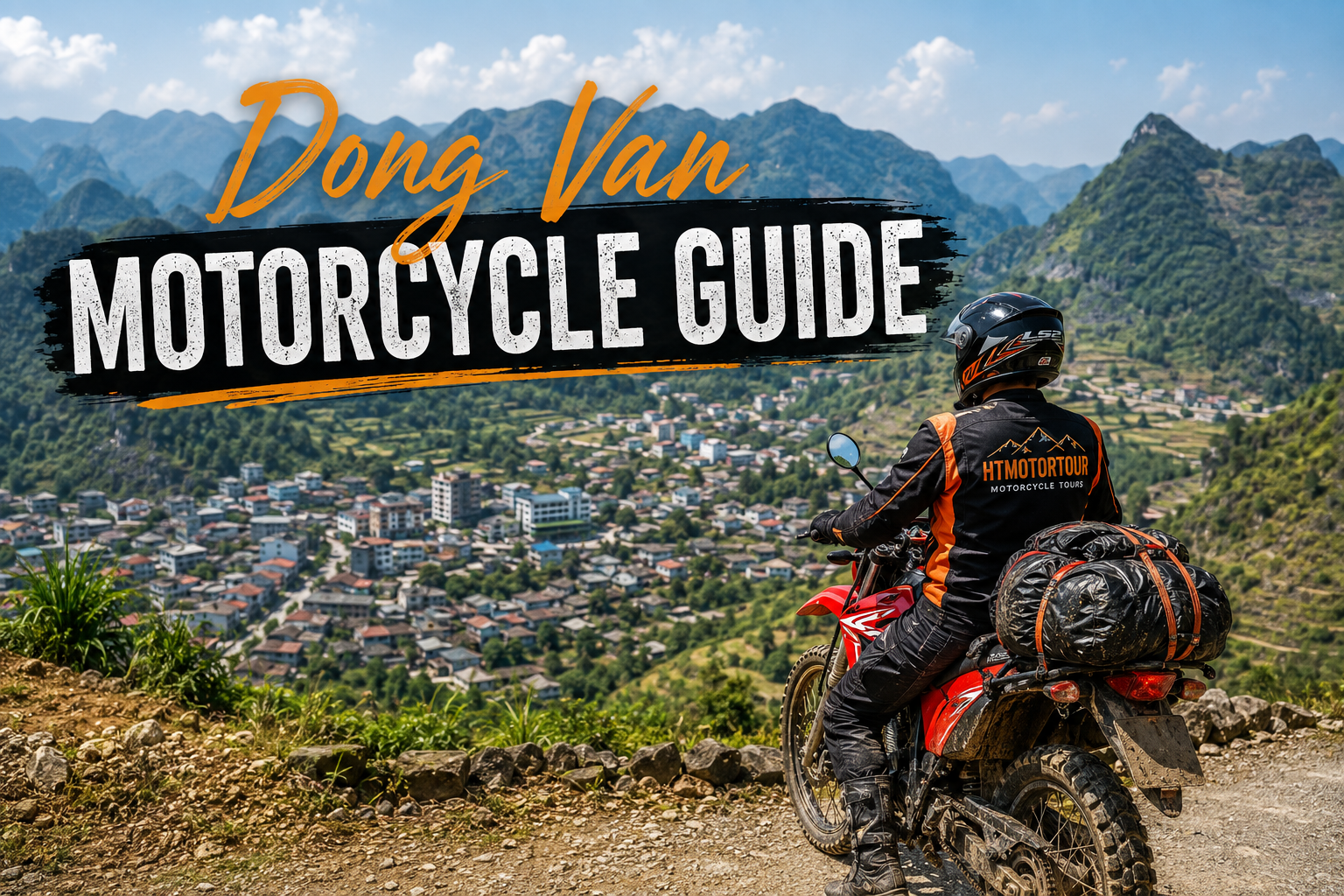

TL;DR: Dong Van is the cultural and riding heart of the northern Ha Giang Loop, sitting between the Tham Ma Pass section and Ma Pi Leng. Arrive by motorcycle through limestone mountains, explore the Old Quarter and Sunday market, then continue toward Lung Cu or Ma Pi Leng.
There is a point on the Ha Giang Loop where the landscape changes.
The road climbs higher.
The limestone mountains become larger.
The valleys become deeper.
And eventually, after hours of mountain riding, you reach Dong Van.
For some travellers, Dong Van is simply where they sleep before riding Ma Pi Leng the next morning.
That is a mistake.
Dong Van deserves more time than that.
It is one of the most important stops on the entire Ha Giang motorcycle route because it brings together the things that make this region special:
mountain riding, karst landscapes, ethnic cultures, history, local markets and some of the best roads in Northern Vietnam.
The town is also perfectly positioned between two of the most memorable riding sections of the loop.
You arrive from the south through Tham Ma Pass, Chin Khoanh Pass and Sung La.
Then you continue north toward Lung Cu, or east toward Ma Pi Leng and Meo Vac.
That makes Dong Van much more than a waypoint.
It is the natural base for exploring the northernmost section of the Ha Giang Loop.
Dong Van at a Glance
| Question | Answer |
|---|---|
| Location | Ha Giang Province, Northern Vietnam |
| Role on the Loop | Major overnight and exploration stop |
| Main approach | Yen Minh → Tham Ma → Sung La → Dong Van |
| Main onward routes | Lung Cu / Ma Pi Leng → Meo Vac |
| Landscape | High limestone plateau |
| Main attraction | Dong Van Old Quarter & surrounding karst mountains |
| Market | Dong Van Sunday Market |
| Nearby cultural site | Vuong Family’s Palace |
| Nearby northern attraction | Lung Cu Flag Tower |
| Best motorcycle experience | 3–4 day Ha Giang Loop |
| Best for | Adventure riders, photographers and cultural travellers |
Dong Van sits inside the Dong Van Karst Plateau UNESCO Global Geopark, an area dominated by limestone landscapes with geological history stretching back more than 550 million years. UNESCO also highlights Dong Van Ancient Quarter and the region’s distinctive ethnic and cultural heritage.
Where Is Dong Van on the Ha Giang Loop?
Direct answer: Dong Van is the main mountain town between Yen Minh and Meo Vac on the classic Ha Giang Loop. Riders normally reach it after crossing Tham Ma and Chin Khoanh Passes, then continue toward Lung Cu or Ma Pi Leng the following day.
The classic route looks roughly like:
Ha Giang City
↓
Quan Ba
↓
Yen Minh
↓
Tham Ma Pass
↓
Sung La
↓
Dong Van
↓
Ma Pi Leng Pass
↓
Meo Vac
↓
Du Gia
↓
Ha Giang City
HT Motor Tour’s current Ha Giang itineraries follow this basic progression, with Dong Van appearing as the overnight stop after the Tham Ma/Sung La section and before Ma Pi Leng.
That positioning makes Dong Van strategically important for motorcycle travellers.
You are not simply arriving at another Vietnamese town.
You are arriving at the high plateau.
And the road ahead becomes even more dramatic.
Why Is Dong Van Important for Motorcycle Riders?
Direct answer: Dong Van is one of the most useful bases on the Ha Giang Loop because it breaks the route into manageable riding days while placing you close to Tham Ma, Sung La, Lung Cu, Ma Pi Leng and Meo Vac. It is where riding and cultural exploration naturally meet.
A good Ha Giang motorcycle itinerary should not be about collecting as many kilometres as possible.
The best rides have rhythm.
You ride.
You stop.
You explore.
You eat.
You talk to people.
Then you ride again.
Dong Van works particularly well because you can do exactly that.
Arrive in the afternoon after a serious mountain-riding day.
Park the motorcycle.
Walk through the Old Quarter.
Eat dinner.
Have a coffee.
Then wake up the next morning ready for another major section of the loop.
That is much better than treating the entire Ha Giang Loop as a race.
Riding to Dong Van: The Yen Minh → Tham Ma → Sung La Route
Direct answer: The approach to Dong Van from Yen Minh is one of the most rewarding motorcycle sections of the Ha Giang Loop. It combines mountain switchbacks, limestone scenery, ethnic villages and famous viewpoints before dropping you into the Dong Van area.
This is the day when the Ha Giang Loop starts feeling genuinely remote.
Leaving Yen Minh, the road climbs and bends through the mountains.
Then comes Tham Ma Pass.
If you have not already read it, our Tham Ma Pass Motorcycle Guide explains the riding character of the pass, its famous switchbacks, safety considerations and how to approach it on a motorcycle.
After Tham Ma, the route continues through the highland landscape toward Sung La and the Dong Van area.
This is where the scenery becomes increasingly dominated by limestone.
The road itself is part of the attraction.
Don’t spend the entire day looking for one particular viewpoint.
Some of the best moments happen between the famous stops.
Tham Ma Pass Before Dong Van
Direct answer: Tham Ma Pass is one of the defining riding sections before Dong Van, famous for its series of tight mountain bends and dramatic views across the limestone landscape. It is best experienced as part of the complete ride from Yen Minh to Dong Van rather than as an isolated photo stop.
From a motorcycle, the experience is very different from seeing photographs online.
You approach a bend.
Slow down.
Look through it.
Turn.
Climb.
Then another corner appears.
The landscape keeps opening up.
This is why we treat Tham Ma → Dong Van as a proper motorcycle section, not simply transportation between two towns.
For riders, the road is the destination.
Sung La Valley: The Road Into Dong Van
Direct answer: Sung La is one of the most attractive valleys on the approach to Dong Van, surrounded by limestone mountains and traditional villages. It is a natural place to slow the ride, photograph the landscape and experience the rural character of the high plateau.
The valley is especially attractive because of the contrast.
The mountains are harsh.
The villages are small.
Agriculture appears wherever the terrain allows it.
Traditional houses sit beneath enormous limestone slopes.
This is one of the reasons the Ha Giang Loop feels different from a conventional motorcycle holiday.
You are not riding through a national park designed entirely around tourism.
You are passing through places where people actually live and work.
Dong Van Old Quarter: Why You Should Walk Around
Direct answer: Dong Van Old Quarter is worth exploring on foot after your riding day because its preserved houses, market architecture and compact streets offer a completely different experience from the mountain roads outside town. It is one of the easiest places on the Loop to slow down and experience local life.
UNESCO notes that Dong Van Ancient Quarter contains around 40 preserved houses dating back to around 1890, with architecture reflecting Chinese and Vietnamese influences and the cultural identity of the surrounding communities.
The Old Quarter is not huge.
That is part of its charm.
You can walk rather than ride.
Look at the old buildings.
Stop for coffee.
Have dinner.
Watch the town become quieter after the day’s motorcycle traffic disappears.
For international riders, this is an important part of the Ha Giang experience.
The best Ha Giang trip is not eight hours on a motorcycle every day.
It is the combination of riding and stopping.
Dong Van Sunday Market
Direct answer: If your itinerary allows it, spending a Sunday morning in Dong Van gives you a chance to experience one of the region’s most important local markets, where ethnic communities from the surrounding mountains come to trade food, livestock, clothing and everyday goods.
The market takes place on Sundays and is closely associated with the Old Quarter and central Dong Van area. Tourism sources describe it as a genuine local trading and social gathering rather than a market created exclusively for tourists.
This is one reason I recommend planning the route around the experience rather than simply following a fixed kilometre schedule.
If you want to visit the Sunday market, the simplest strategy is:
Arrive in Dong Van on Saturday afternoon or evening.
Sleep there.
Wake early.
Visit the market.
Then start your motorcycle day toward Lung Cu or Ma Pi Leng.
That creates a much better experience than trying to arrive at the market halfway through a long riding day.
And remember that this is a working local market.
Be respectful when photographing people.
Ask before taking close-up portraits.
What Can You See Around Dong Van?
Direct answer: Dong Van works as a base for several major Ha Giang attractions, including the Old Quarter, Sunday market, Vuong Family’s Palace, Lung Cu Flag Tower, Sung La and the road toward Ma Pi Leng. Your best choice depends on how many days you have.
The main options are:
Dong Van Old Quarter
Best for history, architecture, food and a relaxed evening.
Dong Van Sunday Market
Best for experiencing local trade and ethnic culture.
Vuong Family’s Palace
Best for history and architecture.
Sung La Valley
Best for landscapes and villages.
Lung Cu Flag Tower
Best for extending your ride toward Vietnam’s northern frontier.
Ma Pi Leng Pass
Best for the major mountain-road experience.
The mistake is trying to squeeze all of these into a few hours.
If you have time, slow down.
Vuong Family’s Palace: A Stop Worth Making
Direct answer: Vuong Family’s Palace, also known as the Hmong King’s Palace, is one of the most important historical sites near Dong Van and makes a natural stop between Sung La and Dong Van. Its stone, timber and terracotta architecture reflects the region’s history and cultural connections.
The palace is in Sa Phin, on the route toward Dong Van.
UNESCO identifies the Vuong Family’s Palace as a cultural landmark within the Dong Van Karst Plateau, noting its use of green stone, Po Mu wood and terracotta tiles, along with decorative motifs associated with royalty and prosperity.
It is particularly easy to include when riding from Yen Minh toward Dong Van.
That makes it a good example of why a motorcycle is useful here.
You are not tied to one bus timetable.
You can stop.
Walk around.
Take your time.
Then continue.
Should You Ride to Lung Cu From Dong Van?
Direct answer: Yes, if you have enough time. Lung Cu is a natural extension from Dong Van for riders who want to explore the far northern part of Vietnam before continuing toward Ma Pi Leng. It is better treated as a dedicated side trip than squeezed into an already overloaded riding day.
The route to Lung Cu takes you deeper toward the northern frontier.
The scenery changes again.
Roads wind through limestone terrain.
Villages become increasingly remote.
And the journey itself becomes more interesting than simply saying:
“I visited the northernmost point.”
If Lung Cu is important to you, give it time.
Don’t treat it as a five-minute checkbox.
Dong Van to Ma Pi Leng: The Next Great Ride
Direct answer: The road from Dong Van toward Ma Pi Leng is the natural continuation of the motorcycle journey, taking riders from the highland town toward one of Vietnam’s most dramatic mountain roads before descending toward Meo Vac.
This is where the sequence becomes particularly powerful:
Tham Ma
→
Dong Van
→
Ma Pi Leng
These are not three unrelated attractions.
They are connected by the motorcycle route itself.
Our Ma Pi Leng Pass Motorcycle Guide covers the next section in detail, including riding conditions, safety, the Dong Van → Meo Vac direction and how long you should allow.
The important thing here is not to duplicate that article.
Instead, think of Dong Van as the gateway to Ma Pi Leng.
Stay here.
Rest here.
Then ride out fresh.
Dong Van to Ma Pi Leng: Why the Overnight Stop Matters
Direct answer: Staying overnight in Dong Van before riding Ma Pi Leng makes sense because it breaks the Ha Giang route into manageable stages and allows you to start the next mountain section rested rather than arriving after an unnecessarily long day in the saddle.
This matters more than many itinerary websites admit.
A motorcycle ride through Ha Giang is mentally tiring.
You are constantly watching:
- Corners.
- Road surfaces.
- Traffic.
- Animals.
- Weather.
- Other motorcycles.
After several hours, your concentration drops.
That is why a sensible itinerary gives riders time to stop.
Dong Van is perfectly positioned for that.
How Many Days Do You Need for Dong Van?
Direct answer: You can pass through Dong Van on a 2-day Ha Giang trip, but 3 days is a better minimum for seeing the major highlights without turning the experience into a race. Four days is the better choice if you want time for Dong Van, Lung Cu, Ma Pi Leng and the surrounding mountain roads.
2-Day Ha Giang Loop
Dong Van is essentially an overnight stop.
HT Motor Tour’s current 2-day itinerary reaches Dong Van on Day 1 after approximately 130 km of mountain riding, including Quan Ba, Tham Ma and the Sung La section, then continues toward Ma Pi Leng and Nho Que on Day 2.
It works.
But it is fast.
3-Day Ha Giang Motorcycle Tour
Three days gives you substantially more breathing room.
HT Motor Tour’s current 3-day highlights tour includes Dong Van, Tham Ma, Vuong Palace, Lung Cu and Ma Pi Leng within the route.
For travellers with limited time, this is a strong compromise.
4-Day Ha Giang Motorcycle Tour
This is our preferred option for most international riders.
Four days allows the route to breathe.
You can ride.
Stop.
Explore.
Photograph.
Eat.
And still enjoy the mountain roads instead of constantly checking the clock.
See the 4-Day Ha Giang Loop Motorcycle Tour from Hanoi for the full route.
5 Days or More
If you are coming to Northern Vietnam primarily to ride, five days or more becomes increasingly attractive.
HT Motor Tour’s 5-Day Ha Giang Big Loop Motorcycle Tour extends the experience beyond the standard loop and includes additional Northern Vietnam landscapes.
For serious adventure riders, you can also look at the Vietnam North-East Motorcycle Tour, which connects Ha Giang and Dong Van with Cao Bang, Ban Gioc and Ba Be.
Is Dong Van Good for Self-Riding?
Direct answer: Dong Van is an excellent destination for experienced self-riders, but reaching it is not the same as riding around a normal Vietnamese town. The approach involves sustained mountain riding, so riders should be comfortable with manual motorcycle control, changing road conditions and long periods of concentration.
This is where honest advice matters.
If you regularly ride motorcycles, Dong Van is one of the places in Vietnam you will probably remember for years.
If you’ve only ridden an automatic scooter around a city or beach resort, don’t assume the experience transfers directly.
The mountain environment is different.
If you’re unsure, read our Ha Giang Loop Safety Guide before choosing self-ride.
What Motorcycle Is Best for Riding to Dong Van?
Direct answer: For most riders, a manageable dual-sport or lightweight manual motorcycle is the best choice for the Ha Giang Loop. The Honda XR150L is a particularly practical option, while larger adventure bikes such as the Royal Enfield Himalayan 450 make more sense for experienced riders comfortable with additional weight.
Honda XR150L
The XR150L is a strong choice for riders who want:
- Manageable weight.
- Simple controls.
- Good ground clearance.
- Enough power for the mountain route.
- A comfortable dual-sport riding position.
HT Motor Tour has a dedicated Honda XR150L Ha Giang Loop guide explaining why the bike is useful on the demanding two-day itinerary.
Honda XR190L
The XR190L is another option for riders who want a little more displacement while staying in a relatively manageable dual-sport format.
See HT Motor Tour’s Honda XR190L rental information if you’re planning to combine Dong Van with a wider Northern Vietnam motorcycle trip.
Royal Enfield Himalayan 450
The Himalayan 450 is a different proposition.
More engine.
More comfort.
More highway capability.
More weight.
For an experienced adventure rider, that can be exactly what you want.
For a nervous beginner, it can be unnecessary weight on tight mountain roads.
Our Royal Enfield Himalayan 450 Vietnam rental guide covers the bike in more detail.
The correct question isn’t:
“Which bike is biggest?”
It is:
“Which motorcycle can I control confidently for several hours on mountain roads?”
Dong Van Motorcycle Tour vs Self-Ride
Direct answer: Self-riding gives experienced riders freedom and flexibility, while a guided Dong Van or Ha Giang motorcycle tour removes much of the navigation and logistical burden. For first-time Vietnam riders, a guided experience can be the better choice even if they are experienced motorcyclists.
Self-Ride Makes Sense If You:
Already ride regularly, are comfortable with manual motorcycles, enjoy navigating independently and want to choose your own stopping points and pace.
Guided Makes More Sense If You:
Want local knowledge, prefer someone else to handle navigation and logistics, are unfamiliar with Vietnamese mountain traffic or simply want to focus on riding and scenery rather than planning every detail.
There is no “correct” answer.
The correct choice is the one that lets you enjoy the mountains without spending the entire trip worrying about logistics.
Best Time to Ride to Dong Van
Direct answer: Dong Van can be visited throughout the year, but the cooler and generally drier periods are especially attractive for motorcycle riding. October–November is popular for the region’s buckwheat landscapes, while March–May offers comfortable riding conditions and spring scenery.
October–November
This is one of the most popular periods.
The weather is cooler and the surrounding mountains can be particularly attractive during the buckwheat season. UNESCO specifically highlights October–November for the region’s buckwheat landscapes.
December–February
Expect colder conditions, especially in the morning and evening.
Fog can also become part of the experience.
Bring proper layers.
March–May
A strong period for motorcycle travel, with greener landscapes and generally pleasant riding conditions.
June–August
Summer brings more rain and the possibility of wet mountain roads, reduced visibility and changing conditions.
The mountains don’t follow your itinerary.
If weather changes, adjust your day.
Where Should You Stay in Dong Van?
Direct answer: Staying near Dong Van Old Quarter is the most convenient option for motorcycle travellers because you can park the bike, walk to restaurants and explore the historic centre without needing to ride again after a long mountain day.
For a normal Loop itinerary, I would prioritize:
Old Quarter / central Dong Van → easy walking → dinner → sleep → breakfast → motorcycle.
If you want to experience the Sunday market, staying in Dong Van on Saturday night is particularly useful.
The exact hotel or homestay matters less than having a convenient base and secure motorcycle parking.
For a motorcycle trip, practicality beats luxury most of the time.
What Should You Eat in Dong Van?
Direct answer: Dong Van is a good place to try Northern Vietnamese mountain food after a long riding day, particularly local dishes and warming meals suited to the cooler highland climate. The best experience is usually a simple local restaurant or homestay meal rather than searching for international food.
Depending on the season and availability, you may encounter:
- Thang Co.
- Local grilled meats.
- Corn-based dishes.
- Buckwheat products.
- Mountain vegetables.
- Local noodles.
- Rice and family-style dishes.
Don’t expect every restaurant to operate like Hanoi.
That’s the point.
You’re in the mountains.
How Much Time Should You Spend in Dong Van?
Direct answer: One night is enough for riders following a normal 3–4 day Ha Giang Loop, but adding an extra night makes sense if you want to explore Lung Cu, visit the Sunday market slowly or take additional local roads around the plateau.
One night
Best for:
Ha Giang Loop → Dong Van → Ma Pi Leng
This is the standard approach.
Two nights
Better if you want:
Dong Van + Sunday Market + Lung Cu + slower exploration
For photographers and riders who dislike rushing, this can be a very good choice.
A Good 4-Day Motorcycle Plan Around Dong Van
Direct answer: A comfortable four-day Loop can place Dong Van on Day 2, giving you enough time to ride through Tham Ma and Sung La before spending the evening in town, then continue through Lung Cu or directly toward Ma Pi Leng on Day 3.
Day 1
Ha Giang → Quan Ba → Yen Minh
A mountain introduction without trying to reach Dong Van immediately.
Day 2
Yen Minh → Tham Ma → Sung La → Vuong Palace → Dong Van
This is your major approach day.
Day 3
Dong Van → Lung Cu → Ma Pi Leng → Meo Vac / Du Gia
The major northern mountain day.
Day 4
Du Gia → Ha Giang
A more relaxed finish through villages and mountain scenery.
HT Motor Tour’s current 4-day Ha Giang itinerary follows the broader structure of reaching Dong Van before continuing through the northern highlights.
Common Mistakes When Visiting Dong Van
Direct answer: The biggest mistake is treating Dong Van as nothing more than a hotel stop. Riders also commonly try to combine too many attractions into one day, arrive too late to explore the town and underestimate how tiring the approach from Yen Minh can be.
The first mistake is obvious once you think about it.
You spend thousands of kilometres travelling to Northern Vietnam.
Then you arrive in Dong Van.
Park the bike.
Sleep.
Leave.
Why?
Walk around.
Have coffee.
Eat local food.
Look at the old buildings.
Talk to your guide or homestay host.
Watch the town change from busy daytime traffic to a quiet mountain evening.
That is part of the journey.
Is Dong Van Worth Visiting on a Motorcycle?
Direct answer: Absolutely. Dong Van is one of the strongest destinations on the Ha Giang Loop for motorcycle travellers because the road into town is spectacular, the town itself has genuine cultural and historical character, and its position makes it the perfect launch point for Lung Cu and Ma Pi Leng.
If you only remember the biggest attraction on the map, you may remember Ma Pi Leng.
But if you remember the journey?
You will probably remember Dong Van too.
The cold morning.
The smell of breakfast.
The old streets.
The motorcycles parked outside.
The limestone mountains surrounding the town.
And the knowledge that another spectacular road is waiting the next morning.
Dong Van vs Meo Vac: Which Is Better for Riders?
Direct answer: Dong Van is generally the better cultural and logistical base, while Meo Vac is more closely associated with the continuation of the Ma Pi Leng route and the southern side of the high plateau. Most first-time riders should experience both rather than choosing only one.
| Dong Van | Meo Vac | |
|---|---|---|
| Old Quarter | Excellent | Limited |
| Sunday market | Excellent | Excellent |
| Historical sites | More | Fewer |
| Lung Cu access | Better | Further |
| Ma Pi Leng access | Excellent | Excellent |
| Riding scenery | Excellent | Excellent |
| Best role | Cultural base | Mountain-route continuation |
For a first Ha Giang Loop, I would not overthink the comparison.
Ride through both.
Dong Van and the Dong Van Karst Plateau
Direct answer: Dong Van sits within the Dong Van Karst Plateau UNESCO Global Geopark, one of Vietnam’s most distinctive geological landscapes. Limestone dominates much of the region, creating the dramatic peaks, valleys and deep canyons that make the Ha Giang motorcycle route so visually different.
UNESCO describes the geopark as an area of approximately 234,500 hectares with geological heritage spanning more than 550 million years and a population representing 17 ethnic groups.
That geological story is easy to forget when you’re focused on riding.
But look around.
Those mountains are not simply scenery.
They explain why the roads are the way they are.
Why villages sit where they do.
Why agriculture is difficult.
Why the route feels so different from the lowlands around Hanoi.
Once you understand that, the motorcycle ride becomes more than just a scenic road trip.
Frequently Asked Questions About Dong Van Motorcycle Travel
Is Dong Van worth visiting?
Yes. Dong Van is one of the most important stops on the Ha Giang Loop, combining mountain riding, history, local culture and access to major attractions such as Lung Cu and Ma Pi Leng.
Is Dong Van part of the Ha Giang Loop?
Yes. Dong Van is a major town on the classic loop between Yen Minh and Meo Vac.
How do I get from Yen Minh to Dong Van by motorbike?
The classic route passes through Tham Ma Pass and Sung La before reaching Dong Van. Allow plenty of time for photographs and mountain-road riding rather than treating it as a simple point-to-point transfer.
Is Dong Van good for self-riding?
Yes, for riders with genuine motorcycle and mountain-road experience. Beginners should consider an Easy Rider or guided tour instead.
Is Dong Van Sunday Market worth visiting?
Yes, particularly if you are interested in local culture and can arrive early on Sunday. It is a working market rather than simply a tourist attraction.
How many nights should I stay in Dong Van?
One night works for most 3–4 day Ha Giang Loop itineraries. Two nights are better if you want time for the Sunday market, Lung Cu and slower exploration.
Can I visit Lung Cu from Dong Van?
Yes. Dong Van is a practical base for the trip toward Lung Cu and the northern frontier.
Is Dong Van close to Ma Pi Leng Pass?
Yes. Dong Van is the natural starting point for the Ma Pi Leng section toward Meo Vac.
For the complete riding details, see our Ma Pi Leng Pass Motorcycle Guide.
What motorcycle should I use for Dong Van?
A manageable dual-sport such as the Honda XR150L is a practical choice for many riders. Experienced adventure riders may prefer larger bikes such as the Royal Enfield Himalayan 450.
How many days should I spend on the Ha Giang Loop?
Three days is a reasonable minimum for the major highlights. Four days is generally better for international riders who want to enjoy the route without rushing.
Can I reach Dong Van directly from Hanoi by motorcycle?
You can, but it is not the route we recommend if you only have a few days for the Ha Giang Loop. Hanoi is roughly 310 km from Ha Giang City, and riding from Hanoi to Ha Giang first adds a substantial amount of time before the actual loop begins. HT Motor Tour’s Hanoi to Ha Giang transport guide explains the available options.
Ready to Ride to Dong Van?
If you’re searching for Dong Van motorcycle tours, the important question isn’t simply:
“How do I get to Dong Van?”
It is:
“How do I experience the road properly?”
For a short trip, HT Motor Tour’s 2-Day Ha Giang Motorbike Loop reaches Dong Van on the first riding day.
For a better balance, choose the 3-Day Ha Giang Motorcycle Tour.
For most international riders, our preferred option is the 4-Day Ha Giang Loop from Hanoi.
And if you want to go beyond the classic loop, the 5-Day Ha Giang Big Loop Motorcycle Tour gives you more time and a broader route.
For experienced adventure riders looking beyond Ha Giang, explore the Vietnam North-East Motorcycle Tour, connecting Dong Van with Cao Bang, Ban Gioc and Ba Be.
The Bottom Line
Dong Van is not simply the place where you sleep between Tham Ma and Ma Pi Leng.
It is the heart of the northern Ha Giang riding experience.
You arrive through one of Vietnam’s best mountain-road sections.
You explore an old highland town.
You can experience one of Northern Vietnam’s most interesting local markets.
You can ride toward Lung Cu.
And then you wake up with Ma Pi Leng waiting ahead.
That is why Dong Van deserves its own place in a proper Ha Giang motorcycle itinerary.
Ride to Dong Van slowly.
Stay the night.
Walk the old streets.
Then get back on the motorcycle and continue north.
0 Comment