
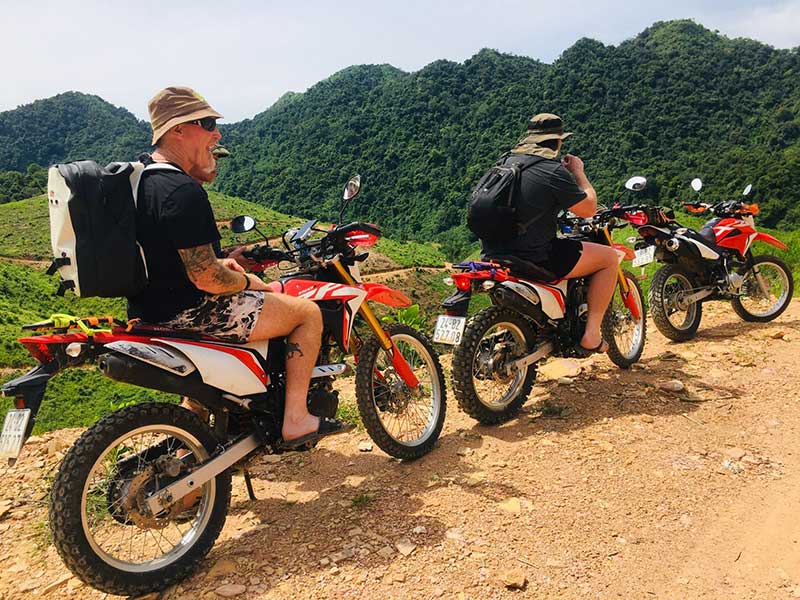

There are roads you remember because of the destination, and there are roads you remember because of the riding. Tham Ma Pass belongs to the second category.
The road climbs through the limestone mountains of Northern Vietnam in a series of tight bends, with the famous winding section visible from above. It’s one of those places where the motorcycle isn’t simply your transportation — the motorcycle is part of the experience. Tham Ma is also one of the most photographed sections of the Ha Giang Loop, but photographs don’t tell you everything.
If you’re planning to ride it, the questions that actually matter are practical: where exactly is Tham Ma Pass, how difficult is it, is the road paved, can a beginner ride it, which motorcycle works best, when should you go, and how does it fit into a 2-, 3-, 4- or 5-day Ha Giang Loop? This guide answers those questions from a rider’s perspective, not just a sightseeing one.
Tham Ma Pass at a Glance
| Question | Answer |
|---|---|
| Location | Ha Giang Province, Northern Vietnam |
| Main route | Yen Minh → Dong Van |
| Road | Paved mountain road |
| Famous for | Tight switchbacks and dramatic mountain views |
| Difficulty | Moderate for experienced riders; demanding for beginners |
| Best approach | Slow, controlled riding |
| Best motorcycle | Lightweight 125–150cc for most riders |
| Best trip length | 3–4 days for the wider Ha Giang Loop |
| Main risks | Blind bends, traffic, wet surfaces, fatigue |
| Nearby highlights | Sung La Valley, Hmong King’s Palace, Dong Van, Ma Pi Leng |
Where Is Tham Ma Pass?
Direct answer: Tham Ma Pass is on the main Ha Giang Loop route between Yen Minh and Dong Van. Riders normally encounter it after leaving Yen Minh and before reaching Dong Van, making it one of the major mountain-road highlights on the northern section of the loop.
That means Tham Ma is normally encountered before Dong Van, while Ma Pi Leng comes later on the Dong Van–Meo Vac section. For riders, this is actually a great progression — you start with easier mountain roads, and the terrain becomes increasingly dramatic. Tham Ma gives you one of the first major switchback experiences; later, Ma Pi Leng delivers the enormous cliff-and-canyon scenery. If you want to understand how the whole route fits together, see our Ha Giang Loop 4-Day Itinerary.
Why Is Tham Ma Pass Famous?
Direct answer: Tham Ma is famous because of its distinctive series of tight bends climbing across the limestone mountains, creating the classic image of a narrow road zigzagging across the hillside. It is also one of the most recognizable riding sections on the Ha Giang Loop.
Look at a photograph from the viewpoint and you immediately understand why — the road appears to fold back on itself, one corner becoming another, then another. From below, it looks like a giant snake climbing the mountain. From the motorcycle, however, it feels different: you’re not looking at the whole road, you’re managing the next corner, then the next. That’s why Tham Ma is particularly interesting for motorcycle travellers — it combines mountain scenery, tight switchbacks, elevation changes, limestone cliffs, rural villages, local traffic and a genuine riding challenge. It’s not somewhere to simply get off the motorcycle and take a photograph. The road itself is the attraction.
Why Is It Called Tham Ma Pass?
According to some local accounts, the name is connected to the historical use of this steep mountain road for testing the strength and endurance of horses — a link to the traditional transportation and working life of the mountain communities, rather than a name invented for modern tourism. Before motorcycles and modern roads transformed travel in Northern Vietnam, horses were important for moving people and goods through the mountains, and the steep terrain wasn’t easy for animals either. That gives the pass a little more meaning than simply being a good photo spot — you’re riding through a landscape where mountain transport has always required skill, patience and endurance. Today, the motorcycle has replaced the horse for most travellers; the mountain hasn’t changed nearly as much.
What Is Riding Tham Ma Pass Actually Like?
Direct answer: Tham Ma is a paved mountain road with repeated tight bends. In dry conditions, a competent rider should find it challenging but manageable. The real difficulty comes from combining steep gradients, switchbacks, traffic, visibility and the need to control your speed continuously.
Ignore both extremes you see online — one side says “it’s easy, anyone can do it,” the other says “it’s one of the most dangerous roads in Vietnam.” Neither is particularly useful. The honest answer is that your riding ability and the conditions matter more than the road’s reputation.
| Conditions | What changes |
|---|---|
| Dry day | Generally manageable for a competent rider — good traction, usually better visibility, you can approach corners progressively. |
| Rain | Wet asphalt reduces available grip, mud or gravel can collect near the edges, braking distances increase, the motorcycle can feel different. |
| Fog | Visibility becomes the bigger problem — you may not see approaching traffic until later than expected. Reduce speed immediately. |
How Many Bends Does Tham Ma Pass Have?
Direct answer: Tham Ma is commonly described as the Nine-Bend Pass because of its famous sequence of sharp curves. The exact visual count can vary depending on which section and viewpoint people include, but the nine-bend description is firmly associated with the pass — you’ll often see it called the Nine-Bend Pass or Nine-Turn Pass when researching the Ha Giang Loop. Don’t become too obsessed with counting them while riding; your priority should be corner, exit, next corner — not working out whether that was bend number seven.
Is Tham Ma Pass Difficult to Ride?
Direct answer: Tham Ma is moderately difficult rather than technically extreme. The road is paved, but the repeated switchbacks require proper low-speed control, smooth braking and patience around blind corners. Complete beginners should not use Tham Ma as their first serious mountain-riding experience.
If you’ve already ridden mountain roads, tight hairpins and manual motorcycles on long days in the saddle, you’ll probably find Tham Ma exciting rather than frightening. If you’re at an intermediate level, this is where Tham Ma becomes an excellent challenge — take it slowly, don’t try to copy the pace of local riders, and give yourself time to understand the motorcycle. If your motorcycle experience is closer to “I’ve ridden a scooter around a beach resort” than “I’m comfortable controlling a manual motorcycle through mountain switchbacks,” this is where we’d recommend stopping and reconsidering. Our honest Ha Giang Loop safety guide explains the difference between basic riding experience and the sustained concentration required on the loop.
How to Ride Tham Ma Pass Safely
Direct answer: The safest approach is simple: slow down before each bend, stay on your side of the road, avoid aggressive overtaking, use controlled braking and never sacrifice road awareness for a photograph. Tham Ma rewards patience much more than speed.
- Slow before the corner. Don’t enter a blind hairpin too fast and then grab the brakes halfway through — reduce speed first, turn second, and accelerate only when you can clearly see the exit.
- Stay on your side. This sounds obvious, but on tight mountain roads, motorcycles, cars, trucks and minibuses can all appear around a blind bend. Never assume the other vehicle will stay perfectly in its lane — give yourself space.
- Don’t copy local traffic. You may see an experienced local rider take a corner at a speed that looks impossible. Don’t copy them — they know the road, you don’t.
- Watch the road surface. Gravel, sand, mud, wet patches, potholes, rocks and animals are all things to watch for. The biggest danger is often not the bend itself, but something unexpected sitting on the road.
- Don’t stop in the riding line. Tham Ma is extremely photogenic, but that doesn’t mean stopping wherever the photo looks good — use a safe viewpoint or pull-off, and move completely away from the traffic line before taking photographs.
- Don’t ride it after dark. There’s no reason to turn a beautiful mountain pass into a night-riding challenge — plan your day around daylight.
Can Beginners Ride Tham Ma Pass?
Direct answer: Complete beginners should not self-ride Tham Ma Pass. Riders with genuine motorcycle experience may be able to handle it, but anyone who is uncomfortable with manual gears, slow-speed control or mountain traffic should choose an Easy Rider instead.
This distinction is important for international travellers. You don’t need to be a professional rider, but you should be able to comfortably control a manual motorcycle, use engine braking, brake smoothly, make tight turns, start on an incline, ride for several hours, stay calm around traffic and adjust your speed to road conditions. If you can’t do those things confidently, don’t turn Ha Giang into your motorcycle training course.
The good news is that you don’t have to miss the experience. An Easy Rider Ha Giang experience — covered in more detail in our Ha Giang Loop safety guide — allows you to experience the same mountain roads while an experienced local rider handles the motorcycle. Same mountains, same road, much less pressure.
What Motorcycle Is Best for Tham Ma Pass?
Direct answer: A light, manageable motorcycle is usually the smartest choice for Tham Ma Pass. For many riders, a Honda XR150L offers a useful balance of control, weight, suspension and power without becoming unnecessarily heavy on tight mountain roads.
This is not a place where “bigger engine equals better motorcycle” necessarily applies. The real question is whether you can control the motorcycle comfortably through repeated slow-speed corners.
Honda XR150L
For many international riders, this is the practical choice — manageable weight, a manual gearbox, useful low-speed control, enough power for mountain roads and a familiar dual-sport riding position. HTmotortour currently offers the XR150L as an upgrade option on its Ha Giang tours, and also has a dedicated Honda XR150L Ha Giang Loop guide.
Honda XR190L
If you want a little more engine capacity while staying in a relatively manageable dual-sport format, the XR190L is worth considering. See our dedicated guide to the Honda XR190L for the Ha Giang Loop.
Royal Enfield Himalayan 450
The Himalayan 450 makes more sense for experienced riders who want a larger adventure motorcycle and are planning more than just a short Ha Giang Loop. It’s capable, has more power and is comfortable for longer distances — but it’s also heavier. For tight mountain switchbacks, choose it because you’re comfortable with a larger motorcycle, not because you think a bigger bike automatically makes the pass easier. See our Royal Enfield Himalayan 450 rental in Vietnam if you’re planning a longer motorcycle trip from Hanoi.
Tham Ma Pass vs Ma Pi Leng Pass
Direct answer: Tham Ma and Ma Pi Leng are both iconic Ha Giang motorcycle roads, but they offer different experiences. Tham Ma is famous for its tight switchbacks and visual road geometry; Ma Pi Leng is famous for its enormous canyon views, high mountain road and Nho Que River below.
| Tham Ma Pass | Ma Pi Leng Pass | |
|---|---|---|
| Main attraction | Switchbacks | Canyon scenery |
| Famous feature | Nine bends | Sky road & Nho Que views |
| Riding feel | Tight, technical curves | Open, exposed mountain road |
| Location | Yen Minh → Dong Van | Dong Van → Meo Vac |
| Best for | Riders who enjoy corners | Riders who want dramatic landscapes |
Don’t choose between them — ride both. They’re part of the reason the Ha Giang Loop is such a strong motorcycle destination. Our Ma Pi Leng Pass Motorcycle Guide covers the next major section of the route in detail.
What Can You See Around Tham Ma Pass?
Direct answer: Tham Ma works best as part of a full riding day rather than as an isolated destination. The surrounding route includes the Sung La Valley, Hmong cultural sites, Dong Van and several other mountain viewpoints.
A typical day looks something like: Yen Minh → Tham Ma Pass → Sung La Valley → Vuong Chinh Duc (Hmong King’s Palace) → Dong Van. This is why trying to calculate the value of Tham Ma by the number of minutes you spend there misses the point — the pass is one part of a much bigger riding experience.
Best Time to Ride Tham Ma Pass
Direct answer: Tham Ma can be ridden year-round, but dry, cooler periods generally make mountain riding more comfortable. October–November is especially attractive for riders who want cooler temperatures and seasonal scenery, while wet-season riding requires more caution and flexibility.
| Period | Conditions |
|---|---|
| Oct – Nov | One of the most attractive periods for the region — cooler temperatures, generally more comfortable riding, excellent mountain scenery and seasonal agricultural landscapes. |
| Dec – Feb | Cold mornings, potential fog, very atmospheric landscapes. Bring proper riding layers. |
| Mar – May | A good period for motorcycle travel — temperatures are generally more comfortable than summer, and the mountains become increasingly green. |
| Jun – Aug | Weather deserves more attention — heavy rain can make mountain riding more difficult, with wet roads, reduced visibility, mud, rockfall and occasional temporary road problems. Keep your itinerary flexible. |
How Long Should You Spend at Tham Ma Pass?
Direct answer: Most riders don’t need hours at Tham Ma itself. Allow roughly 20–30 minutes for a proper viewpoint stop, photographs and a short break, then continue toward Sung La and Dong Van. The real experience is riding the entire section, not standing at one viewpoint.
Don’t build your entire day around “Tham Ma Pass” — build it around Yen Minh → Tham Ma → Sung La → Dong Van. That’s a much better motorcycle day. And if you’re continuing toward Ma Pi Leng afterward, don’t spend your energy trying to tick every viewpoint — you still have mountain roads ahead.
How Does Tham Ma Fit Into the Ha Giang Loop?
Direct answer: Tham Ma is normally part of the northern section of the classic Ha Giang Loop, usually after Yen Minh and before Dong Van. It fits naturally into a 3- or 4-day itinerary and becomes rushed when the entire loop is compressed into only two days.
| Your available time | Recommended experience | Why |
|---|---|---|
| 2 Days | 2-Day Ha Giang Motorbike Loop | Major highlights, fast pace — HTmotortour’s current 2-day route reaches Dong Van via Tham Ma and Chin Khoanh Pass on Day 1, then continues through Ma Pi Leng and the Nho Que River on Day 2. It works if you only have two days, but you need to accept the pace. |
| 3 Days | 3-Day Ha Giang Highlights Tour | A much better minimum for travellers who want the major highlights — includes the major mountain roads, designed around roughly six hours of riding per day. |
| 4 Days | 4-Day Ha Giang Loop Tour from Hanoi | Our preferred option for most travellers — more time for viewpoints, villages, food, photography, weather changes and rest. |
| 5 Days | 5-Day Ha Giang Big Loop | For travellers who want to explore Northern Vietnam properly rather than simply “do the Ha Giang Loop” — goes beyond the standard highlights and connects Ha Giang with additional mountain landscapes and Ba Be. |
| 7+ Days | North Vietnam Adventure Motorcycle Tours | Serious motorcycle expeditions connecting Ha Giang with other regions. |
Self-Ride or Guided Tour?
Direct answer: Experienced riders who are comfortable with manual motorcycles and mountain roads can consider self-riding. First-time Vietnam riders, inexperienced mountain riders or travellers who simply want to concentrate on the scenery should choose a guided or Easy Rider experience.
- You already ride motorcycles regularly
- You’re comfortable with manual gears
- You have mountain-road experience
- You can navigate independently
- You understand Vietnamese traffic conditions
- You’re comfortable riding 5–6 hours a day
- This is your first motorcycle trip in Vietnam
- You’re uncertain about the route
- You want local knowledge
- You don’t want to manage accommodation and logistics
- You want someone experienced handling changing road conditions
There’s no prize for proving you can do everything yourself. The objective is to have an excellent motorcycle trip.
What Should You Carry on a Tham Ma Pass Ride?
Direct answer: Keep your riding luggage light and carry the essentials rather than a large backpack. Weather protection, water, phone/navigation, basic personal items and secure luggage are more useful than bringing everything you packed for Vietnam.
Useful essentials include riding gloves, a waterproof jacket, a small water bottle, sunscreen, sunglasses, a power bank, a phone mount, basic personal medication, cash in Vietnamese dong, your driving documents and travel insurance details, plus a lightweight clothing layer. Avoid carrying a huge backpack — after several hours of mountain riding, you’ll feel every unnecessary kilogram.
Common Mistakes Riders Make at Tham Ma Pass
Direct answer: The most common mistakes are riding too quickly into blind bends, stopping in unsafe places for photographs, following another rider’s speed and underestimating fatigue. Tham Ma is much easier when you treat it as a mountain road rather than an attraction.
- Chasing the perfect photo. The best photograph is not worth stopping in traffic — find a safe viewpoint instead.
- Riding too fast. The road is not a racetrack. The scenery will still be there.
- Overtaking on blind corners. Don’t. You don’t know what’s coming.
- Choosing a motorcycle you can’t control. A 450cc motorcycle may look impressive, but that doesn’t help if you’re uncomfortable controlling it through a tight hairpin.
- Trying to complete too much in one day. Ha Giang looks compact on Google Maps. It isn’t — the mountains change everything.
Tham Ma Pass for First-Time Vietnam Riders
Direct answer: If you’ve never ridden in Vietnam but have solid motorcycle experience elsewhere, Tham Ma can be part of a guided Ha Giang trip with sensible preparation. If you’ve never ridden a manual motorcycle on mountain roads, don’t make this your first serious riding experience.
Vietnamese mountain traffic can be different from what you’re used to — motorcycles, trucks, cars, minibuses, dogs, buffalo, pedestrians, children and unexpected road obstacles are all part of the mix. This is why road awareness matters more than technical riding style. If you’re uncertain, read our Ha Giang Loop safety guide before deciding.
Tham Ma Pass: The Rider’s Verdict
Direct answer: Tham Ma Pass is one of the best short riding sections on the Ha Giang Loop because it gives you something Ma Pi Leng does not: the feeling of actively working your way through a mountain road rather than simply looking at a spectacular landscape.
Ma Pi Leng makes you stop and stare. Tham Ma makes you ride. That’s the difference — the bends, the elevation, the limestone, the changing road, the sound of the engine. Then you crest the pass, look back and see the road you’ve just climbed folding across the mountain. That’s the photograph. But the photograph is not the experience. The ride is.
Frequently Asked Questions About Tham Ma Pass
Is Tham Ma Pass worth visiting?
Where is Tham Ma Pass?
Is Tham Ma Pass paved?
How many bends does Tham Ma Pass have?
Is Tham Ma Pass dangerous?
Can beginners ride Tham Ma Pass?
What motorcycle is best for Tham Ma Pass?
How long should I spend at Tham Ma Pass?
Is Tham Ma Pass the same as Ma Pi Leng?
What is the best time to ride Tham Ma Pass?
Can I include Tham Ma Pass in a 2-day Ha Giang tour?
🏔️ Ready to Ride Tham Ma Pass?
If you came here because you searched “Tham Ma Pass motorcycle,” you probably don’t need another generic travel article — you need to decide how you want to ride it.
0 Comment