
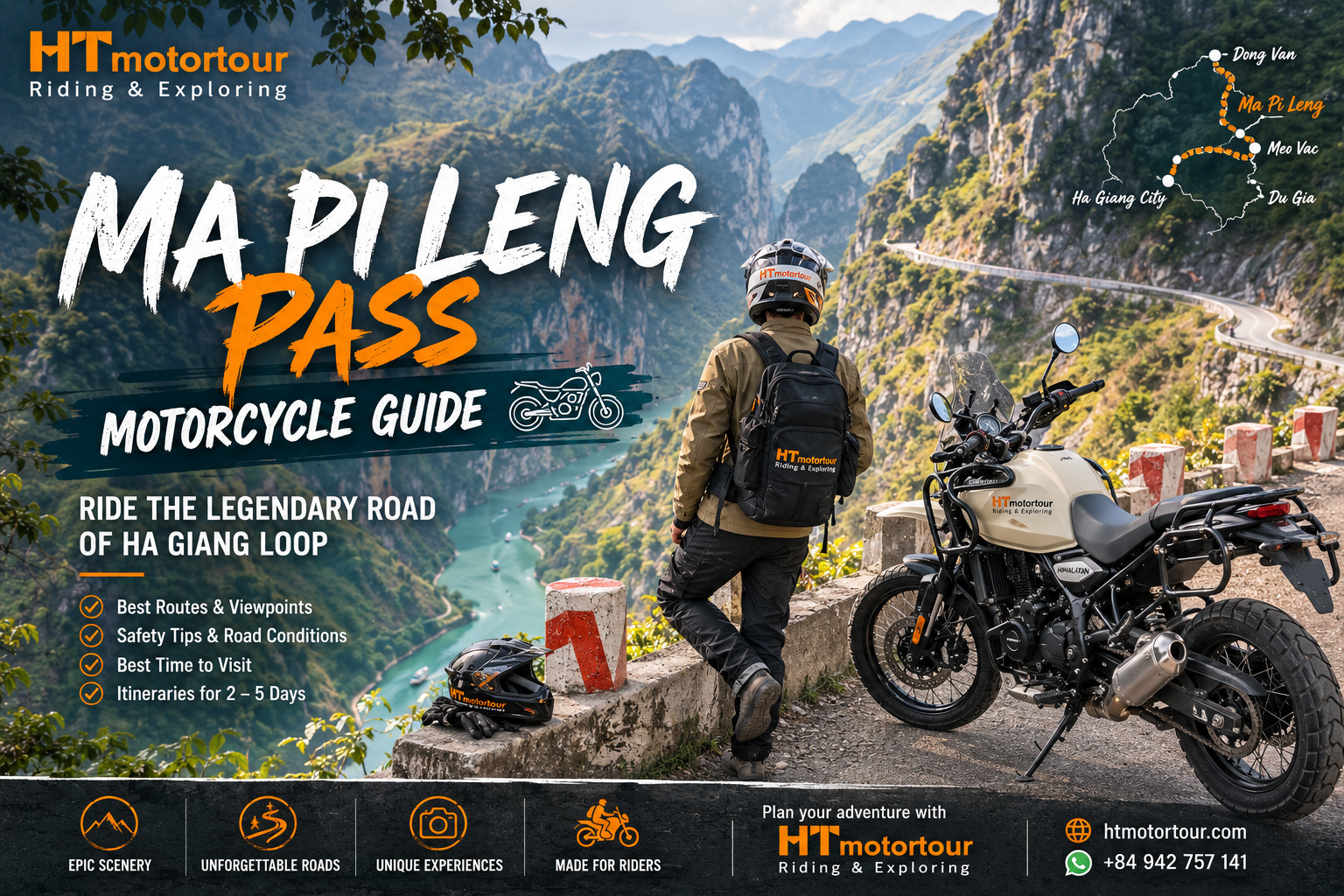

There are mountain roads that are beautiful. Then there are mountain roads that make you stop the motorcycle, take off your helmet and simply stand there for a minute. Ma Pi Leng Pass is one of those roads.
The road runs through the limestone mountains between Dong Van and Meo Vac, high above the Nho Que River and the dramatic Tu San Canyon. For many riders, this is the moment the Ha Giang Loop becomes more than just another motorcycle trip.
But Ma Pi Leng also creates the same questions again and again: Is it dangerous? Can beginners ride it? Is the road paved? Should you ride from Dong Van to Meo Vac or the other direction? What motorcycle is best? Is a 2-day Ha Giang tour enough, or should you allow 3, 4 or 5 days? This guide answers those questions directly — and helps you decide which Ha Giang motorcycle experience actually fits your available time and riding ability.
Ma Pi Leng Pass at a Glance
| Question | Short Answer |
|---|---|
| Location | Between Dong Van and Meo Vac, Ha Giang |
| Length | Around 20 km |
| Road | Paved mountain road |
| Best direction | Dong Van → Meo Vac |
| Difficulty | Moderate; conditions matter more than technical skill |
| Main risks | Rain, fog, fatigue, overconfidence |
| Best time | March–May and September–November |
| Famous view | Nho Que River and Tu San Canyon |
| Recommended trip length | 3–4 days for most travellers |
| Beginner-friendly? | Not ideal for complete beginners riding alone |
What Makes Ma Pi Leng Pass So Special?
Direct answer: Ma Pi Leng is special because the road itself runs through one of Vietnam’s most dramatic limestone landscapes. You are not simply riding toward a viewpoint — the entire journey between Dong Van and Meo Vac is the experience.
The pass lies within the Dong Van Karst Plateau UNESCO Global Geopark, a landscape dominated by limestone formations, deep canyons and high mountain roads. UNESCO specifically highlights Ma Pi Leng as one of the geopark’s major scenic roads, rising to around 1,200 metres with views toward the Nho Que River below.
What makes the experience memorable for motorcycle riders is the combination of long mountain curves, limestone cliffs, constant changes in elevation, deep valleys, the Nho Que River far below, small villages and changing light and weather. You can be riding under clear blue skies one hour and enter cloud or fog the next — that unpredictability is part of the experience. It’s also why Ma Pi Leng deserves respect.
Where Is Ma Pi Leng Pass?
Direct answer: Ma Pi Leng Pass sits on the route between Dong Van and Meo Vac in Ha Giang, Northern Vietnam. It is one of the defining sections of the Ha Giang Loop and normally forms part of the journey through the Dong Van Karst Plateau.
The classic direction is: Ha Giang → Quan Ba → Yen Minh → Dong Van → Ma Pi Leng Pass → Meo Vac → Du Gia → Ha Giang. For most riders, Ma Pi Leng is reached on the second or third riding day, depending on the itinerary — and by that point you’ve already spent hours riding mountain roads. Fatigue matters. The road itself is not necessarily the hardest road you’ll ever ride, but concentration can drop after a long day of hairpin bends, photo stops, mountain weather, traffic and changing road surfaces.
This is one reason a longer route usually gives riders a better overall experience than trying to compress the Ha Giang Loop into the shortest possible timeframe. For the complete context of where the pass fits into the wider route, read our Ha Giang Loop 4-Day Itinerary.
Dong Van to Meo Vac: The Classic Ma Pi Leng Motorcycle Route
Direct answer: The best-known direction is Dong Van to Meo Vac. This route lets you leave Dong Van, enter the dramatic mountain section gradually and experience the most famous Ma Pi Leng scenery before descending toward Meo Vac.
The route is simple on paper. The experience is not. You leave Dong Van and begin climbing through increasingly dramatic limestone scenery — the mountains become steeper, the views become larger, and you start seeing why this section of road has become the symbol of the Ha Giang Loop.
Is Ma Pi Leng Pass Dangerous?
Direct answer: Ma Pi Leng is not a technical off-road challenge, and the main road is paved. However, it is a serious mountain road with steep drops, changing weather and sections where sustained concentration is essential. Most problems come from rider behaviour rather than extreme technical difficulty.
This is where internet videos can be misleading — you see a narrow road next to a huge drop, and it looks terrifying. The reality is more balanced: the main challenge is sustained attention rather than extreme technical riding, as covered in more depth in our Ha Giang Loop safety guide. That doesn’t mean you should underestimate it.
The main risks
| Risk | What to do about it |
|---|---|
| Overconfidence | Ma Pi Leng rewards smooth, controlled riding — not speed. Scenery encourages riders to relax; don’t enter a corner too quickly. |
| Rain | Reduces visibility and traction. Brake more smoothly and corner more conservatively. |
| Fog | One of the biggest challenges. If visibility drops, slow down — there’s no prize for reaching Meo Vac five minutes earlier. |
| Fatigue | Ma Pi Leng is often reached after hours of mountain riding. Take breaks, drink water, don’t try to finish the whole loop in one heroic push. |
| Riding after dark | Avoid it. Views disappear, visibility drops, and mountain roads become far less forgiving. |
Can Beginners Ride Ma Pi Leng Pass?
Direct answer: Riders with basic motorcycle experience can manage Ma Pi Leng with the right pace and preparation, but complete beginners should not attempt the Ha Giang Loop alone simply because the road is famous on social media.
There’s an important difference between “I have never ridden a motorcycle” and “I have some riding experience but have never ridden in Vietnam’s mountains.” If you’re completely new to motorcycles, self-riding the Ha Giang Loop is not the right place to learn. If you have experience and understand cornering, downhill braking, speed control and wet-road riding, Ma Pi Leng can be manageable with a conservative approach. If you’re unsure, read Ha Giang Loop for First-Time Riders before deciding whether to self-ride — a guided or Easy Rider-style experience may be a better choice than forcing yourself onto a motorcycle you’re not ready to control.
What Is the Best Motorcycle for Ma Pi Leng Pass?
Direct answer: The best motorcycle is the one you can control confidently. For most riders, a lighter adventure or dual-sport motorcycle is easier to manage on Ha Giang’s tight mountain roads than a much larger motorcycle chosen purely for engine size.
Honda XR150L — Best for Most Riders
A lighter motorcycle gives you several advantages: easier low-speed control, easier manoeuvring, less intimidating on mountain roads, and more confidence when stopping or parking. The Honda XR150L rental guide is particularly relevant for riders who want a simple, manageable motorcycle for the Ha Giang Loop — for many international travellers, this is the smarter choice than renting the biggest bike available.
Honda CRF300L — For Riders Wanting More Adventure
The Honda CRF300L rental guide is better suited to riders who want more capability beyond standard paved roads. For the main Ma Pi Leng route, you don’t need a CRF300L — but it becomes more attractive if your wider Northern Vietnam itinerary includes rougher roads or more adventurous detours.
Royal Enfield Himalayan 450 — For a Bigger Adventure
The Royal Enfield Himalayan 450 rental guide is a strong option for experienced riders planning a longer adventure beyond the standard Ha Giang Loop — particularly if your route continues into Northeast Vietnam, Ba Be, Ban Gioc, the Northwest, or a longer Vietnam journey. Remember: more engine capacity doesn’t automatically mean an easier ride. On Ma Pi Leng, confidence matters more than horsepower.
For riders comparing different options, HTmotortour’s best motorcycle tours in Vietnam guide provides a wider overview of routes and motorcycle styles.
Ma Pi Leng Pass and the Nho Que River
Direct answer: The Nho Que River is one of the visual highlights of Ma Pi Leng, winding far below the pass through the dramatic limestone landscape. Many Ha Giang itineraries combine the mountain ride with a boat experience.
From Ma Pi Leng, you’re high above the valley. Later, you can experience the landscape from the river itself. The Nho Que River runs through the spectacular Tu San Canyon, which UNESCO describes as one of Southeast Asia’s deepest canyons, with depths of roughly 700–800 metres.
If you only have a limited amount of time, plan your day realistically. Trying to ride Ma Pi Leng, visit every viewpoint, arrange a river trip and continue a long distance before dark can turn a great day into a rushed one — another reason a 4-day Ha Giang itinerary is the best balance for many travellers.
What Is the Best Time to Ride Ma Pi Leng Pass?
Direct answer: March to May and September to November generally offer the most comfortable balance of temperatures and riding conditions. However, every season changes the landscape, and mountain weather can never be guaranteed.
| Period | Conditions |
|---|---|
| Mar – May | Comfortable riding weather, more manageable temperatures than winter, landscape becomes greener — conditions can still change quickly at altitude |
| Jun – Aug | Lush but wetter — heavy rain, wet roads, reduced visibility, occasional disruptions. Still possible, but stay flexible |
| Sep – Nov | One of the strongest periods for a Northern Vietnam trip — cooler conditions, and this is also Ha Giang’s buckwheat flower season (peaking around October–November) |
| Dec – Feb | Cold, atmospheric, fog more likely to affect visibility. Can be memorable if properly equipped, but not the easiest season for inexperienced riders |
How Long Do You Need to Experience Ma Pi Leng Properly?
Direct answer: You can technically see Ma Pi Leng during a 2-day Ha Giang trip, but 3 or 4 days gives you a far better riding experience. The more time you have, the less you need to rush the mountain roads.
| Your available time | Recommended experience | Best for |
|---|---|---|
| 2 Days | 2-Day Ha Giang Motorbike Loop Tour | Very limited time — you’ll still see Ma Pi Leng and the Nho Que River, but with more moving and less slowing down |
| 3 Days | 3-Day Ha Giang Highlights Tour | A good middle ground — Dong Van Plateau, Lung Cu, Ma Pi Leng, Nho Que River, Du Gia, without a full four-day schedule |
| 4 Days | 4-Day Ha Giang Loop Tour from Hanoi | Our recommendation — the sweet spot for most international travellers. For a self-guided version, see our Ha Giang Loop 4-Day Itinerary |
| 5 Days | 5-Day Ha Giang Big Loop Tour | Riders who want to explore beyond the most famous stops |
| 7+ Days | North Vietnam Adventure Motorcycle Tours | Serious riders and longer adventures connecting Ha Giang with other regions |
For the 3-day option and to compare all current Ha Giang tour lengths in one place, see the full Ha Giang Loop Tours overview.
Self-Guided or Guided: Which Is Better for Ma Pi Leng?
Direct answer: Self-guided riding offers freedom, while a guided motorcycle tour provides route knowledge, logistical support and an easier option for riders unfamiliar with Vietnam. The better choice depends on your experience, not your ego.
- You have genuine motorcycle experience
- You’re comfortable navigating
- You can adapt to changing weather
- You understand Google Maps isn’t a substitute for riding judgement
- You prefer complete independence
Before committing, read our Ha Giang safety guide.
- It’s your first time riding in Vietnam
- You’re unfamiliar with mountain roads
- You want local route knowledge
- You don’t want to organise accommodation and logistics
- You want support if plans change
The value of a guide is not simply someone riding in front. A good guide understands when weather is changing, which roads are worth taking, when a group needs a slower pace, where to stop, and when to skip a stop because conditions are no longer suitable. On a road like Ma Pi Leng, that experience can matter.
How to Ride Ma Pi Leng Pass Safely
Direct answer: Ride slower than you think you need to, stay focused through every corner and adjust immediately when weather or visibility changes. The goal is not to prove that you are brave. The goal is to finish the road safely and enjoy it.
- Ride during daylight. Better scenery, better visibility, more margin for error.
- Don’t chase another rider’s speed. The rider in front may have more experience, a lighter bike, better tyres, or more familiarity with the route. Ride your own pace.
- Slow down before the corner. Do your braking before entering — don’t rush toward a bend and panic-brake halfway through.
- Stop only where it’s safe. The views are tempting, but don’t stop suddenly mid-road for a photo. Wait for a proper safe area.
- Respect rain and fog. If the weather changes, your riding should change — reduce speed, increase distance, don’t force your original schedule. The mountains will still be there tomorrow.
- Never ride after drinking. On a mountain road, there is no safe amount of impaired judgement.
Common Mistakes at Ma Pi Leng Pass
Direct answer: Most mistakes are caused by trying to turn a spectacular mountain road into a social-media stunt, rushing an itinerary or riding beyond your actual level of experience.
- Trying to finish the Ha Giang Loop too quickly — the map may say 350 km, but the mountains don’t care what the map says. A short distance can still mean hours of concentration.
- Choosing a motorcycle that’s too big — a bigger engine doesn’t make a rider better. If a lighter XR150L gives you more confidence than a large adventure motorcycle, choose the XR150L.
- Riding for photos instead of riding the road — look at the road, stop for photos, then look at the road again. The mountains aren’t going anywhere.
- Ignoring weather — don’t assume a clear morning means a clear afternoon. Keep your itinerary flexible.
- Booking the shortest possible tour without considering the experience — two days may fit your flight schedule, but that doesn’t automatically make it the best trip. If you have four days, use them.
Ma Pi Leng Pass vs the Rest of the Ha Giang Loop
Direct answer: Ma Pi Leng is the most famous single section of the Ha Giang Loop, but it is not the entire reason to ride Ha Giang. The best trips combine the pass with Dong Van, Meo Vac, Du Gia and the quieter mountain roads between them.
Think of Ma Pi Leng as the headline act. But the complete experience includes: Quan Ba (the transition from lower roads into the mountain landscape), Yen Minh (a useful overnight stop and gateway to the higher plateau), Tham Ma Pass (one of the most recognisable roads before Dong Van), Dong Van (a historic mountain town and important stop before Ma Pi Leng), Ma Pi Leng (the iconic cliff road), Meo Vac (a natural point to slow down after the pass), and Du Gia (a quieter finish with villages and a more relaxed atmosphere).
Ma Pi Leng is the destination page. Our Complete Ha Giang Motorcycle Tour Guide explains how the whole journey fits together.
Frequently Asked Questions About Ma Pi Leng Pass
Is Ma Pi Leng Pass worth visiting?
How long is Ma Pi Leng Pass?
Is Ma Pi Leng Pass dangerous?
Can beginners ride Ma Pi Leng?
Is Ma Pi Leng Pass paved?
Which direction is best?
What is the best motorcycle for Ma Pi Leng?
How many days do I need?
What is the best time to visit?
Final Verdict: Is Ma Pi Leng Pass the Best Motorcycle Road in Vietnam?
Direct answer: Ma Pi Leng deserves its reputation, but the best way to experience it is not to treat it as a quick photo stop. Give yourself enough time, ride at your own pace and make it part of a complete Ha Giang motorcycle journey.
The road is spectacular. But what you remember later may not be one specific viewpoint. It may be the moment the mountains opened in front of you. The sound of the motorcycle echoing between limestone cliffs. The sudden appearance of the Nho Que River below. Or simply the feeling of arriving safely in Meo Vac after one of the most memorable rides of your life.
That is Ma Pi Leng. And that is why it deserves more than one rushed hour on an overloaded itinerary.
🏔️ Ready to Ride Ma Pi Leng Pass?
Choose the Ha Giang experience that matches your available time.
0 Comment